Rep. Aguilar Announces $1 Million to Expand Inland Empire Artificial Intelligence Education and Workforce Development
Kim Anthony • February 6, 2026

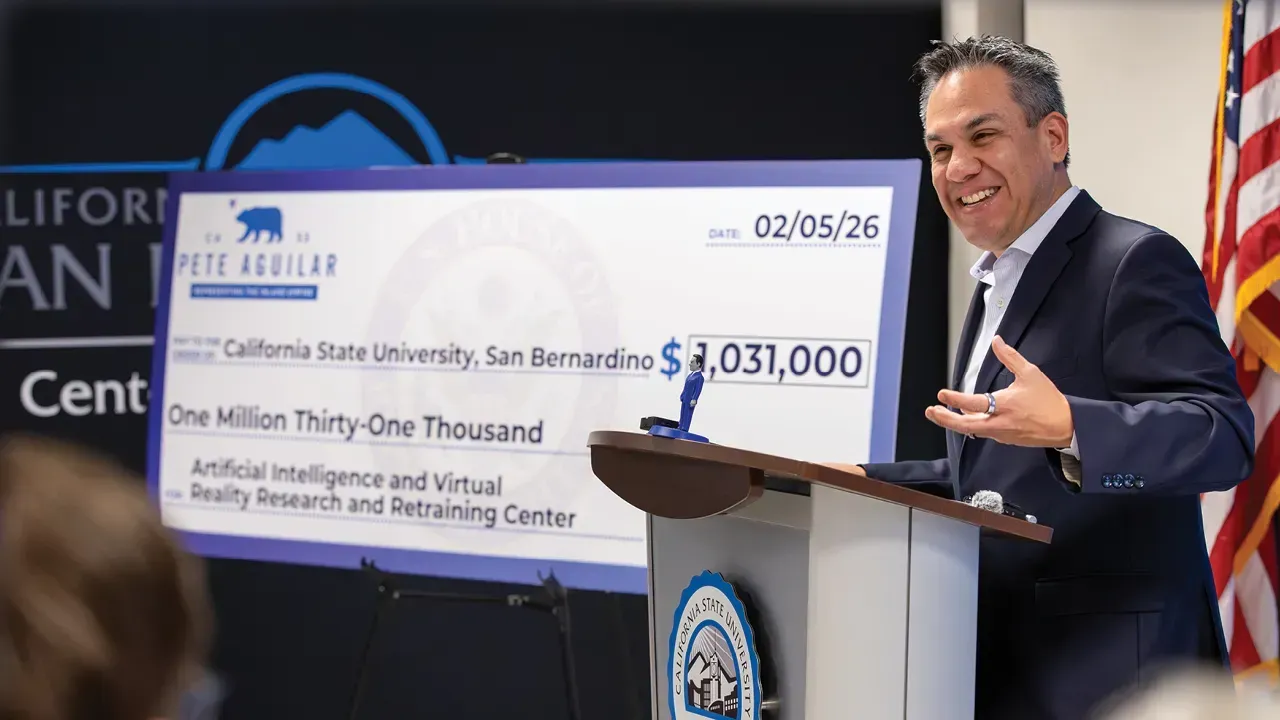
(SAN BERNARDINO, CA) Rep. Pete Aguilar (CA-33) announced $1 million in federal grant funding for California State University, San Bernardino (CSUSB), in collaboration with the University of California, Riverside (UCR), to expand and enhance artificial intelligence (AI) education and workforce development in the Inland Empire. The U.S. National Science Foundation’s Hispanic-Serving Institutions (HSI) Program will provide a $600,000 grant to CSUSB and a $400,000 grant to UCR.


“As the artificial intelligence workforce rapidly expands and evolves, it is essential that students in the Inland Empire have the skills and knowledge they need to have successful careers in this growing field,” said Rep. Pete Aguilar. “This grant funding for CSUSB and UCR is an important investment in our students’ futures, our region’s workforce and our community’s economic development.”


“With this NSF grant, we will launch new academic programs in AI, establish a community-focused AI Help Desk, and expand research opportunities for all students in the Inland Empire,” said Dr. Yunfei Hou, Executive Director of the Leonard Transportation Center and Professor of Computer Science and Engineering at CSUSB. “These efforts will provide students with hands-on experience solving real-world challenges, strengthen the region’s workforce, and create flexible pathways into AI careers.” 


“We at UCR are delighted to partner with CSUSB on this grant and provide students in the Inland Empire with a world-class education in AI,” said Dr. Evangelos Papalexakis, Professor and Ross Family Chair in Computer Science at the Computer Science and Engineering Department at UCR. “This grant aligns with our ongoing efforts on interdisciplinary AI education and research and the campus-wide RAISE@UCR AI institute, which encompasses around 100 faculty from different departments and colleges and where AI serves as the connective tissue across disciplines.”


The funding comes as part of the U.S. National Science Foundation’s (NSF) Hispanic-Serving Institutions: Enriching Learning, Programs, and Student Experiences (HSI:ELPSE) grant program. The project, Promoting Regional Opportunities for Practical and Engaged Learning in AI (PROPEL AI), will allow CSUSB to develop new AI-focused academic programs, create an AI Help Desk that supports local businesses and organizations and build inclusive pathways into AI careers for first-generation and underrepresented students. Additionally, the grant funding will allow UCR graduate students to mentor CSUSB undergraduate students on innovative AI research and joint research projects.
By Kim Anthony July 16, 2026
(ONTARIO, CA) For years, the Toyota Arena has been one of the Inland Empire's premier destinations for concerts, hockey, and major events. Soon, it may become the centerpiece of something much bigger. Just east of the arena, one of the region's most ambitious mixed-use projects—one designed to transform surface parking lots into a vibrant district where people can live, work, dine, and gather year-round is underway. For entrepreneurs and small business owners, the project represents more than new construction. It represents new customers. A New Downtown Experience The development envisions a walkable, mixed-use neighborhood adjacent to Toyota Arena featuring residential housing, restaurants, retail, public gathering spaces, and entertainment. At full build-out, Adept's long-range vision includes up to 2,000 residential units, approximately 130,000 square feet of retail and dining, and 75,000 square feet of public open space. The City of Ontario is planning complementary investments around the project, including an entertainment district envisioned with restaurants, live entertainment venues, a performing arts center, hotel accommodations, and additional public amenities. Together, the public and private investments could reshape the area into one of Southern California's most active entertainment destinations. More Than Apartments While new housing often captures headlines, mixed-use developments create something equally valuable: economic ecosystems. Residents need coffee shops, fitness studios, childcare providers, accountants, salons, pet services, restaurants, insurance agents, financial advisors, medical offices, and countless other neighborhood businesses. Every new apartment creates demand for local entrepreneurs. Every event at Toyota Arena becomes another opportunity for businesses to attract visitors before and after concerts, hockey games, and community events. Creating a Place to Gather A centerpiece of the vision is the proposed Ontario Arena Plaza, a two-acre public gathering space between Toyota Arena and the Adept development. Plans call for landscaped public spaces, water features, outdoor gathering areas, and restaurant concepts designed to encourage visitors to linger rather than simply arrive for an event and leave afterward. City planning documents describe the plaza as the "living room" of the future entertainment district—an economic catalyst connecting arena visitors with surrounding restaurants, retailers, and businesses. Why It Matters for Small Business Large developments often generate headlines because of their construction budgets. The bigger story is what happens after the ribbon cutting. Restaurants need local suppliers. Retailers need accountants and marketing firms. Property managers hire landscapers, maintenance companies, security firms, cleaning services, and technology providers. Professional service firms gain new clients. Independent retailers gain new foot traffic. Entrepreneurs gain access to a growing customer base. For Inland Empire business owners, developments like this can create years of opportunity—not just during construction, but long after the last building opens. A New Chapter for Ontario Ontario has spent the past decade establishing itself as a logistics, convention, and aviation powerhouse. Now it's adding another dimension: destination placemaking. The city's broader Arena District plan includes approximately 700 residential units, commercial space, public plazas, restaurants, entertainment venues, and future phases featuring a performing arts theater, hotel, and additional mixed-use development. Construction on the initial phase began in 2025. As the project succeeds, the district won't simply bring more visitors to Ontario. It could create one of the Inland Empire's strongest environments for entrepreneurs looking to open, expand, or relocate their businesses. Photo Credit: Ontario Ranch Life
Barista smiling at laptop behind coffee shop counter with menu boards and pastries
By Kim Anthony July 15, 2026
Artificial intelligence is no longer just for Silicon Valley. It's helping Inland Empire entrepreneurs write marketing campaigns, create social media content, answer customer emails, build business plans, design presentations, and save hours of administrative work every week. And local business advisors are making sure small businesses don't get left behind. The Orange County Inland Empire Small Business Development Center (OCIE SBDC) has begun integrating artificial intelligence into its training, workshops, and one-on-one advising, introducing entrepreneurs to practical tools like ChatGPT, Microsoft Copilot, Canva AI, and other business automation platforms. The goal isn't to replace people—it's to help entrepreneurs spend less time on repetitive tasks and more time growing their businesses. For many small business owners, time is their most limited resource. A restaurant owner may spend hours writing social media posts. A consultant may struggle to create proposals. A nonprofit leader may spend an entire day drafting a grant application. AI-powered tools can help produce a strong first draft in minutes, giving business owners more time to focus on serving customers and generating revenue. Across the Inland Empire, entrepreneurs are already putting AI to work in practical ways: Drafting marketing emails and newsletters Creating social media graphics and videos Writing product descriptions for online stores Summarizing meeting notes Developing business plans and pitch decks Conducting market research Responding to customer inquiries Translating content into multiple languages For many microbusinesses with one or two employees, AI functions like an extra member of the team—helping owners accomplish work that previously required hiring outside specialists. That can be especially meaningful for startups and entrepreneurs by necessity, where every dollar and every hour matter. Opportunity Through Technology While headlines often focus on whether artificial intelligence will replace jobs, local business advisors see another story unfolding. For small businesses, AI is becoming an equalizer. It allows entrepreneurs to produce professional-quality marketing, organize information more efficiently, improve customer service, and make data-informed decisions without needing a large staff or expensive software. Like the arrival of email, websites, or social media, AI represents another shift in how business gets done. Those who learn to use it thoughtfully may find themselves better equipped to compete in an increasingly digital economy. For the Inland Empire's small businesses, the question is no longer whether artificial intelligence is coming. It's already here. The opportunity is learning how to use it wisely.
By Kim Anthony July 15, 2026
When most people think about starting a business, they don't imagine mealworms. But for Dr. Gina Oliver and Richard Hutchison , two Inland Empire innovators from Yucaipa, that unlikely idea became the foundation for a company with the potential to transform food production, sustainability, and economic opportunity. The founders of From the Land set out to solve two growing challenges: food insecurity and the high cost of traditional agriculture. Their solution is a compact, energy-efficient micro-farming system that allows families and entrepreneurs to produce food—and potentially generate income—from small spaces. Their journey accelerated after participating in California's small business support ecosystem. They received business guidance, technical assistance, and a $10,000 California Dream Fund grant, which helped them refine their business model and build a working prototype. They later secured a $100,000 Phase I Small Business Innovation Research (SBIR) grant, allowing them to continue developing their technology. Their farming system is designed to operate off the electrical grid using proprietary technology that combines solar power, environmental monitoring, and sustainable growing methods. One early demonstration focused on raising mealworms, creating multiple revenue streams through fertilizer, reptile feed, and other agricultural products. The founders envision adapting the same technology for vegetables, herbs, poultry, and other small-scale farming applications. Since then, the company has continued to grow. Through programs at the University of California, Riverside, the founders refined their concept, won the SoCal OASIS Pitch Challenge , joined the EPIC startup program, and secured additional funding—including a $250,000 Catalyst Fund grant —to expand their "Littlest Big Farm" concept. For Inland Empire communities where access to healthy food and economic opportunity can be limited, the company's vision extends beyond farming. Their goal is to create neighborhood-scale micro-farms that help residents grow food, lower costs, and build small businesses from their own properties. Opportunity doesn't always arrive in the form of a large employer moving into town. Sometimes it begins with an entrepreneur who sees a problem differently. From the Land demonstrates how technical assistance, mentoring, and strategic funding can help transform an innovative idea into a business with the potential to create jobs, strengthen local food systems, and expand economic mobility throughout the Inland Empire. Thinking about starting or growing a business? The Inland Empire Small Business Development Center (SBDC) provides no-cost one-on-one business advising , workshops, and guidance on financing, marketing, government contracting, and business growth for entrepreneurs throughout Riverside and San Bernardino counties.
Show More